Since my hike on the GR-R2, I’ve had one desire: to try a hammock. My friend Camille had brought one on our excursions and I must admit it made me envious, for two reasons in particular. Firstly, being isolated from the ground; it may seem like a small detail, but when the ground is damp, dusty, sandy… I find it quickly becomes quite unpleasant to set up camp, not to mention the damaging effect on zippers.
Secondly, when the time comes, at dusk, to relax at the bivouac after a long day of walking, I must admit I’m rarely comfortable. I’m tall, not very flexible, and therefore rarely well settled, sitting on the ground or on a vaguely flat root. So seeing my friend comfortably installed in his hammock with his little book made me jealous more than once.
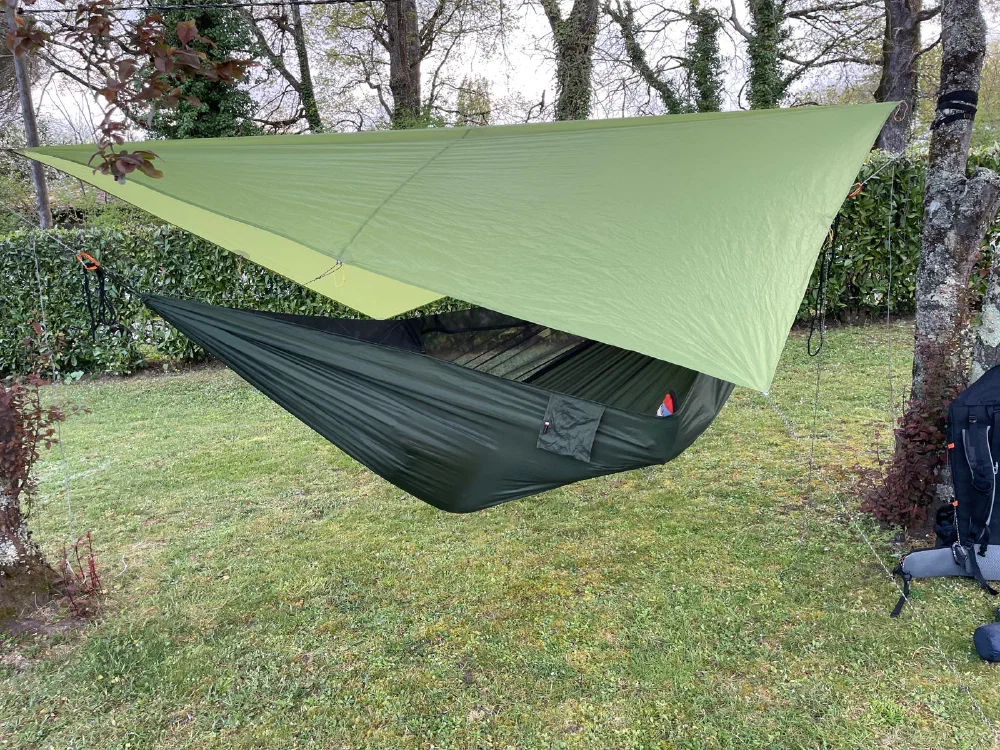
Without further ado, when I returned from that trip, I ordered on the military.eu website a relatively lightweight and especially very large hammock, the Ważka V1 “long” model from the Polish brand TigerWood.
Let me reassure you, I have no morbid fascination for the military, but this site offers an incredible selection of inexpensive hiking gear. The quality is sometimes below expectations, but for testing small things, it’s ideal, and you sometimes get good surprises.
There are many techniques for hanging a hammock, with various ropes and knots. As a complete beginner, I opted for a ready-to-use system from the same brand, using flat straps to avoid damaging tree bark. It’s simple, quick and very easy to adjust thanks to the whoopie sling system that allows you to adjust the rope length.
There are naturally other methods for attaching a hammock, the only point of attention being to plan a water break system for rainwater:
Regarding the height of the strap attachment, a good reference is eye level. This advice is obviously to be adjusted if you’re not very tall and the hammock touches the ground.

Perhaps one of the most persistent misconceptions is that you have to sleep lengthwise in a hammock, in the famous “banana” position. Nothing could be further from the truth! If it’s for reading or taking a twenty-minute nap, why not. But if you plan to spend the night, your back will quickly let you know that’s not how it’s going to work. In reality, to sleep well in a hammock, you need to position yourself diagonally across the fabric. Yes, it’s this position that will allow you to be as flat as possible. If your setup is well done, you should be able to sleep on your back or on your side without too much trouble; however, forget about sleeping on your stomach.


This is where the trouble lies: a hammock requires special equipment to sleep comfortably, namely the underquilt. The idea is simple: rather than sleeping in a sleeping bag whose insulation gets compressed between your body and the fabric, rendering it ineffective, you use a “half-quilt” that goes under the hammock and thus retains its properties.

If you want to take the logic further and with a view to saving weight, you would also use a top quilt, which is the upper counterpart to the underquilt (logically), to cover yourself. So that’s potentially two additional accessories to acquire. I conducted my little test with my excellent Cumulus LITE LINE 300 sleeping bag with a comfort temperature of 4°C, which was forecast that night and… I was cold. Not unbearably cold, I managed to sleep, but it was certainly not comfortable, especially at the contact points with the fabric: the hips, the shoulders, the head.
Let’s be honest, the underquilt is therefore essential for three-season use, so that’s something to consider if you want to switch entirely to a hammock on your next trip.
In the Aquitaine region where I live, it’s absolutely unthinkable to sleep outside without a good mosquito net, because in the warm season, mosquitoes - tiger or otherwise - are out and about. My hammock has a built-in mosquito net, sewn directly to the fabric and fitted with a zipper. In my opinion, this is the best solution, although it is possible to buy the hammock and mosquito net separately, but it’s a bit less optimised in terms of weight and setup speed.
Finally, if you plan to go out for several days with your hammock as your only shelter, you’ll need to get a tarp to protect yourself from the rain. I used a very simple polyester tarp from the brand Flame Creed (it’s cheap AliExpress stuff), measuring 3 x 2.5 m. Given the length of my hammock, it’s a bit tight, which is why I placed it diagonally, to gain a few precious decimetres. Normally, a large tarp of the right length would be better suited, but you work with what you have.
Once again, there are different ways to hang it; I opted for one of the simplest: two cords at each end, tensioned around the trunks using a taut line hitch, or taut tarp hitch.

To finish this little setup, you just need to secure the two remaining corners of the tarp to the ground using stakes and everything is ready for a good night’s sleep!
Summary:
| Tent | Hammock |
|---|---|
| 980g (without stakes): I use a Six Moon Design Haven | ~1200g (without stakes, tarp included) |
| Can be set up almost anywhere | Requires two trees at the right distance (less easy than it seems) |
| Can leak if poorly installed or tensioned | Supposedly well isolated from the ground, therefore less humid |
| Moderately comfortable, depending on the sleeping pad used | This is probably debatable, but I find the hammock very comfortable |
| Not great for relaxing in the evening at the bivouac | Ideal for reading or even sitting at camp |
In summary, choosing a hammock over a tent is above all a matter of taste (and weight). I don’t think one system can be considered better than the other, but this first experience made me really want to test my hammock over a longer period, perhaps in milder conditions to start with.